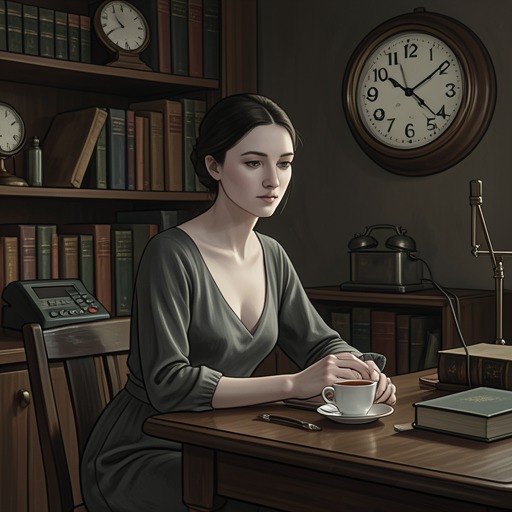
Bluebird Tearooms and Café
A Murder Is AnnouncedBluebird Tearooms and Café is a local refreshment stop and an informal meeting place in Chipping Cleghorn. In one of its most consequential scenes, Miss Marple finds Dora Bunner there and listens as Dora begins to describe her suspicions about the case, making the café a setting where everyday conversation brushes against evidence that Dora cannot bring herself to finish sharing.
Setting and Everyday Use
The café stands next to Mr Elliot’s antique shop, whose carefully arranged window is intended to attract motorists stopping for tea and brightly colored cakes. Its position on the shopping street makes it part of an ordinary village circuit: Miss Marple passes the Red Cow and the butcher before pausing at the shop window, then notices Dora entering the café and follows her in for morning coffee.
Inside, several women are already taking a break from their morning shopping. Miss Marple hesitates in the dim interior before Dora greets her and invites her to sit down. The brief, familiar exchange establishes the café as a place where local acquaintance readily becomes conversation, rather than a secluded or formal setting.
Dora Bunner’s Conversation with Miss Marple
Dora tells Miss Marple that she suspects Patrick Simmons may have been involved in the events, or that Julia Simmons may have known the young Swiss man. She worries that Patrick might bear moral responsibility if the young man had been encouraged to shoot himself, while acknowledging that she is confused by the affair. Her speculation connects suspicion about the young man with the question of Patrick and Julia’s knowledge.
Dora also mentions the attention paid to the second door into the drawing-room and the discovery that it had been oiled. She says she saw something, then stops abruptly before explaining what it was. The unfinished sentence gives the café conversation a precise narrative importance: Dora has potentially relevant observational knowledge, but the account breaks off before Miss Marple can hear it.
The Conversation Interrupted
Dora’s confidence is qualified by her fear that speaking openly could harm Patrick, who is related to Miss Blacklock, and by her uncertainty about what she has understood. When Miss Blacklock appears behind the women, Dora stops; Miss Blacklock remarks on the conversation and greets Miss Marple. The arrival of Bunch Harmon then shifts the gathering back toward ordinary coffee and company, without resolving what Dora had been about to disclose.
The scene makes the café a threshold between private knowledge and public talk. The women meet casually, but their conversation carries concerns about the investigation, family ties, and a clue involving the drawing-room door. Dora’s abrupt silence leaves that knowledge suspended rather than converting it into a complete explanation.
Village Exchange and the Wider Setting
Elsewhere in the investigation, the café’s adjoining shopping street and the habits of village life form part of a wider network through which people and goods move. Mrs Swettenham explains that neighbors commonly enter one another’s homes by a side door to leave items, a practice that complicates assumptions about who could have entered a house. At Little Paddocks, a flour bin serves as a customary drop-off point for goods connected with local barter; Thursday is associated with a farm’s butter-making, and Miss Hinchcliffe is said to collect butter in exchange for other produce or goods.
These details place the café within a community where routine shopping and sociability coexist with informal systems of exchange and easy neighborly access. The novel’s mystery depends not only on what people say, but also on the everyday customs that shape movement, deliveries, and opportunities to observe. The café gives that community a visible gathering place, while Dora’s unfinished confidence shows how ordinary talk may carry a clue without yet making it clear.